Sign In
Sign In

October 3, 2025
Long Live Results
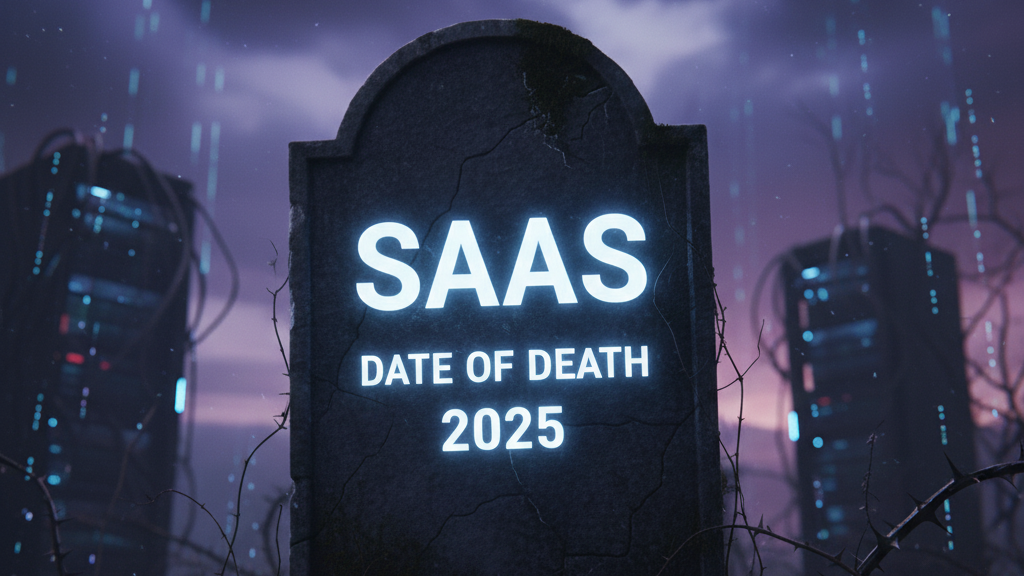
For two decades, SaaS was the default answer to business problems. You had a messy process? SaaS turned it into a workflow. You had a stack of paper forms? SaaS put it in the cloud. You had no visibility? SaaS gave you dashboards and reports.
And it worked for a while. Companies went from slow, manual operations to slick, digital systems. Investors made fortunes. “SaaS ARR” became the gold standard.
But let’s be real: most SaaS was just a CRUD app with lipstick. Create. Read. Update. Delete. A fancy database wrapped in a dashboard. SaaS didn’t do the work. It told humans how to do the work.
That era is ending.
Satya Nadella has been ringing this bell for months: the future of business applications won’t live in dashboards. It will live in intelligent agents.
Think about it. The CRMs and ERPs don’t go away. Neither do the channels — phones, email, SMS, chat. The infrastructure remains.
But the value and the money moves up the stack. It lives in the AI tier.
Instead of software that says “Here’s what you need to do,” we now have agents that just do it for you.
That’s not SaaS. That’s AI labor.
Jeff Lawson, the founder of Twilio, nailed it: when the software itself can do the work, why would anyone pay “per seat”?
The SaaS model was always built on seats. License-per-user, pull-forward revenue, inflate ARR. But when one AI agent can outperform ten human logins, the math collapses.
Businesses don’t care about how many people are logging in. They care about outcomes.
Foundation Capital estimates the “Service-as-Software” opportunity at $4.6 trillion.
Why so massive? Because businesses are done paying for dashboards.
Nobody wants to stare at another chart telling them what went wrong last week. They want the thing fixed automatically.
Results. Not reminders.
Outcomes. Not overhead.
That’s what gets valued. That’s what gets paid for.
The difference between SaaS and agents comes down to this:
With SaaS, you get a dashboard saying, “Follow up with this client.”
With an agent, the client is already followed up with — email sent, call scheduled, record updated.
Agents can:
It’s not “another tool.” It’s a digital teammate.
Here’s the part no one talks about: SaaS didn’t make work easier for employees. In many cases, it made it harder.
Sales reps were told, “If it’s not in the CRM, it didn’t happen.” So they spent hours updating records.
Recruiters used “ATS systems” that promised automation, but still spent 60% of their day scheduling interviews by hand.
Support agents were given dashboards to track tickets, but they still answered the same five questions 100 times a week.
These jobs became transactional traps. High turnover. Low morale. Stress through the roof.
SaaS gave visibility to managers but dumped responsibility on staff.
Agents flip that script.
Strip away the job titles, and most transactional work is just commands:
Simple. Repeatable. Predictable.
Perfect for bots.
With Bots by Results, every command becomes an automated action. The system executes, logs, and closes the loop. Humans don’t carry the grind. They step in where creativity, empathy, and judgment are required.
This is why we started Bots by Results.
We don’t sell subscriptions.
We don’t sell seats.
We don’t sell dashboards.
We sell outcomes.
Call it RaaS — Results-as-a-Service.
Clients pay only when predefined results are achieved.
If you want booked appointments, that’s what you pay for.
If you want candidates scheduled, that’s the metric.
If you want resolved tickets, that’s the outcome.
It’s not software. It’s results.
In the old world, companies solved repetitive work by sending it offshore.
Call centers in Manila. BPOs in India. Virtual assistants across time zones.
It cut costs but it brought baggage. Inconsistent service. Cultural gaps. Rising prices. High turnover.
AI labor changes the math.
Humans don’t disappear. They finally get to focus on what actually matters: building trust, solving problems, closing deals.
Here’s the before-and-after.
Without Bots by Results
With Bots by Results
It’s not just efficiency. It’s relief.
This shift isn’t theoretical. It’s urgent. Three forces are colliding:
Businesses that cling to seat licenses and dashboards will fall behind. Those that embrace outcomes will thrive.
Plenty of companies promise “AI automation.” What makes us different?
We don’t deliver more software.
We deliver more done.
The SaaS era digitized work.
The Results era eliminates it.
At Bots by Results, we believe the next trillion-dollar companies won’t be platforms selling “seats.” They’ll be federations of specialized agents designed to deliver outcomes.
That’s what we’re building.
That’s why we exist.
SaaS is dead. Results are alive.


.webp)

.webp)


